
After successfully and efficiently capturing circulating tumor cells (CTCs) — addressing a key challenge in liquid biopsy — we have further enabled the in vitro culture and expansion of CTCs, reconstructing patient tumor characteristics and providing a new platform for drug screening and personalized treatment.
Using Labyrinth® inertial microfluidic technology, we achieve no-loss enrichment and high-purity recovery of CTCs. The in vitro 3D co-culture technology effectively simulates the tumor microenvironment, induces the expansion of trace amounts of CTCs beyond the cell number bottleneck, while successfully preserving the patient's original pathological features. This serves as an ideal in vitro model for testing drug sensitivity and studying resistance mechanisms, supporting clinical precision medicine.
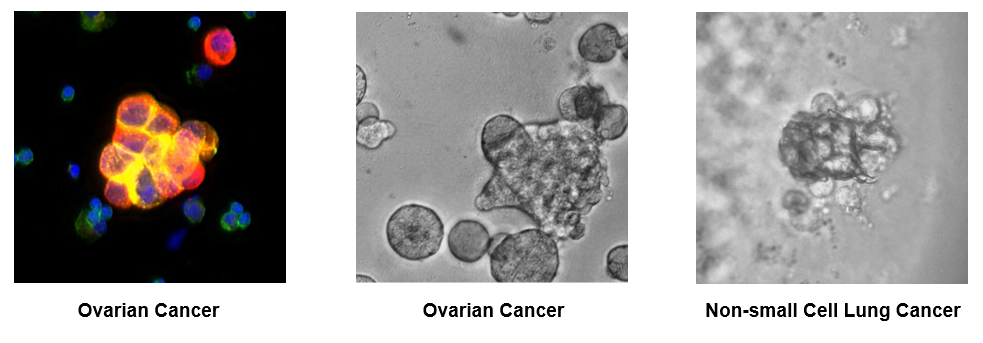

Globally exclusive ability to establish primary CTC cell lines across multiple cancer types, supporting the expansion of highly heterogeneous tumors such as pancreatic cancer, lung cancer, and breast cancer.

CTC-derived preclinical models, including 2D culture, spheroid models, 3D organoid culture, and CDX models. Among these, 3D organoid culture offers advantages such as stable morphology, preservation of tumor characteristics, high-throughput drug screening, low cost, and ease of operation.

The humanized immune 3D-PDX model can combine human peripheral blood PBMCs with the 3D-PDX model, achieving highly realistic immunotherapy research and improving screening effectiveness and reliability.

The humanized 3D-PDX model with immunity can realistically simulate the in vivo effects of immunotherapy and quickly screen out the most suitable immunotherapy schemes.