
In the wave of precision oncology, liquid biopsy is transforming the landscape of cancer diagnosis and treatment at an unprecedented pace. At the core of this revolution, circulating tumor cells (CTCs), as one of the three pillars of 'liquid biopsy,' carry immense expectations for capturing tumor traces from the blood and guiding personalized therapy.
Two major studies, published in Frontiers in Oncology and Cancer Treatment and Research Communications respectively, showcased breakthrough advancements of the Labyrinth® technology in CTC capture and applications. These two studies not only confirmed the significant potential of this technology in early screening but also, for the first time, successfully used it to establish long-term culturable tumor cell lines, paving a new path for research and drug screening of rare tumors.
Early Lung Cancer Detection: What Does 84.4% Sensitivity Mean?
The first study was conducted by the Suzhou Labyrinth team in collaboration with the First Affiliated Hospital of the University of Science and Technology of China, enrolling 167 patients with pulmonary nodules and 31 healthy volunteers, aiming to evaluate the auxiliary diagnostic value of CTC captured by the Labyrinth® system as an early lung cancer biomarker.
The results are encouraging:
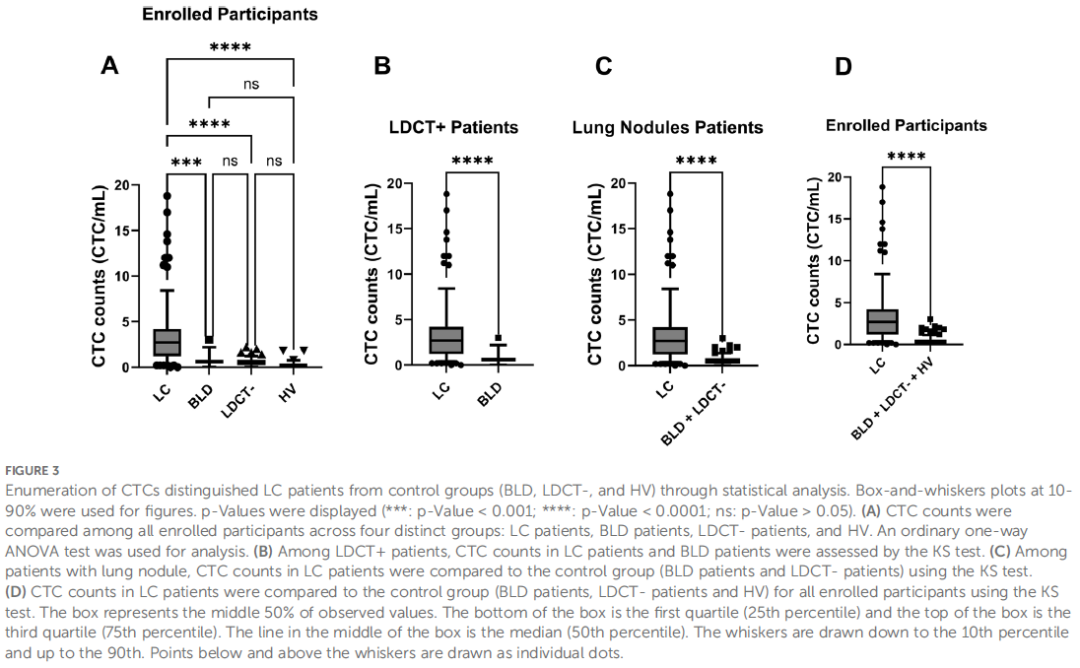
• The median CTC in lung cancer patients reached 2.7 CTC/mL, while patients with benign lung diseases had only 0.6 CTC/mL, and the healthy control group had 0;
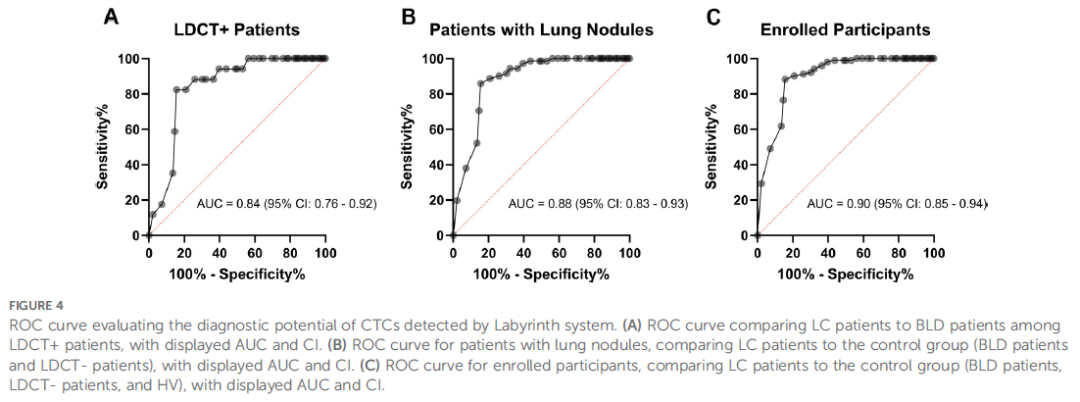
• Using 1 CTC/mL as the threshold, in LDCT-positive patients, the sensitivity of CTC detection reached 84.4% and specificity reached 82.4%; when expanded to all patients with lung nodules, specificity further increased to 85.9%;
• ROC curve analysis shows that the AUC (area under the curve) is as high as 0.90 among all participants, indicating that the test has extremely high diagnostic accuracy.
What is even more noteworthy is that among the 96 patients diagnosed with lung cancer, 84 were early-stage stage I patients. This indicates that the Labyrinth® system is capable of effectively detecting CTCs when the tumor is still at a curable stage, compensating for the shortcomings of traditional imaging in identifying tiny lesions.
At the same time, the research team also captured CTC clusters—a type of cell population believed to be closely related to the tumor's metastatic potential—further confirming the potential of this technology in revealing tumor invasive behavior.
From 'Capture' to 'Cultivation': Building 'Living' Models for Rare Tumors
If the first study demonstrated the value of the Labyrinth® system in assisting diagnostics, then the second study, conducted by the Suzhou Labyrinth team and the Peking Union Medical College Hospital team, expanded its application boundaries to the fields of basic research and drug development.
Malignant ovarian germ cell tumor (MOGCT) is a rare tumor that commonly occurs in adolescents and young women, with limited treatment options and a lack of stable, well-characterized in vitro models. Traditional methods of isolating primary cells from surgical tissue often fail due to fibroblast contamination or insufficient cell viability.
The Peking Union Medical College Hospital team innovatively focused on intraoperative peritoneal lavage fluid or ascites—taking advantage of the fact that ovarian tumors tend to disseminate within the peritoneal cavity, these fluids are rich in exfoliated tumor cells. With the efficient enrichment provided by the Labyrinth® system, the researchers successfully isolated high-purity tumor cells from samples of 15 patients and cultured them in vitro.
The results are encouraging:
• The tumor cells captured from ascites had an average density of up to 1082 cells/mL, much higher than that in peripheral blood;
• 5 samples were successfully expanded to over 10⁵ cells, with the longest culture reaching 18 passages, establishing stable patient-derived tumor cell lines;
• STR identification confirmed that the cultured cells are completely consistent with the genotype of the patient's original tumor, and contamination from known cell lines was ruled out;
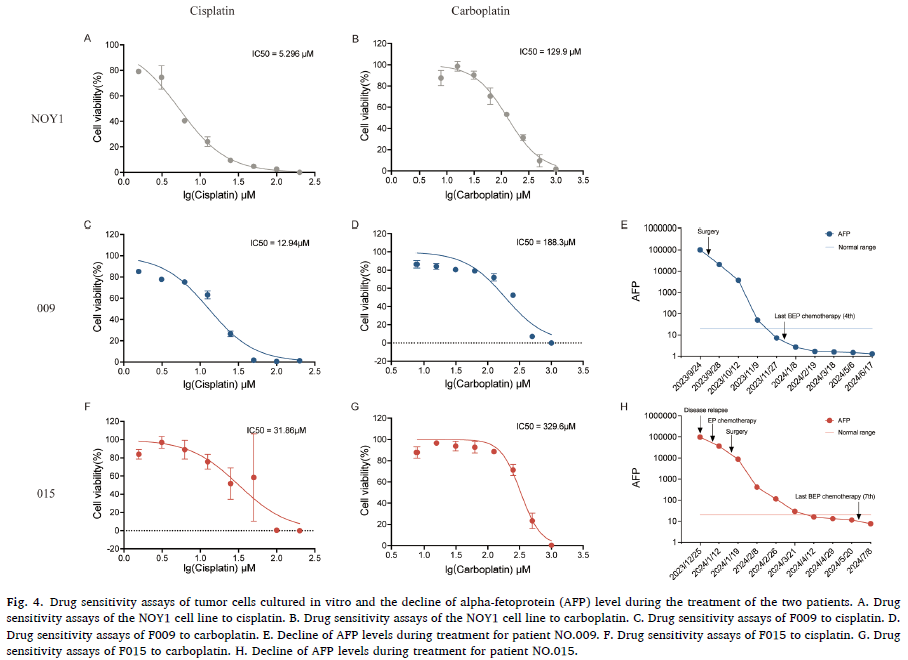
• Preliminary drug sensitivity tests showed that cell lines from different patients exhibited significant differences in response to cisplatin and carboplatin, which highly corresponded to the trend of alpha-fetoprotein (AFP) decline observed in the patients during clinical treatment.
This means that Labyrinth's technology not only can 'capture' CTCs, but also, while maintaining cell viability, enables the in vitro expansion and functional study of tumor cells. For rare tumors like MOGCT, which lack research models, this undoubtedly opens a door to personalized precision therapy.
Current Status of Precision Tumor Treatment and the 'Breaking Point'
Currently, precision tumor therapy is undergoing an evolution from being 'based on genetic typing' to 'based on functional phenotyping.' Pure genetic testing can reveal mutation profiles, but it cannot answer the crucial question of 'whether this drug is actually effective for this patient.'
Patient-derived tumor cell lines (PDC) and patient-derived xenograft models (PDX) are considered the 'gold standard' for predicting drug responses, but their establishment takes a long time, has a low success rate, and is costly, making it difficult to popularize in clinical practice.
Labyrinth® technology provides a standardized, repeatable, and high-success-rate protocol for enriching and culturing patient-derived tumor cells. Whether from peripheral blood or ascites, it can obtain highly pure and highly active tumor cells in a short time, providing a reliable 'seed' for subsequent drug sensitivity testing, mechanism research, and even PDX model construction.
In the future, perhaps every cancer patient, during surgery or biopsy, will be able to leave behind a 'living' tumor cell bank through Labyrinth® technology, which can be used for drug sensitivity screening, exploration of drug resistance mechanisms, and even personalized vaccine development—from 'finding a needle in a haystack' to 'planting and cultivating seedlings,' Labyrinth is making all of this possible.
References: